
Definition: Understanding the effective functioning of individuals, groups and teams through a systems lens and applying behavioral science knowledge towards elements of organization culture, leadership & diversity to support successful change.
The role of a creative leader is not to have all the ideas; it’s to create a culture where everyone can have ideas and feel they’re valued
Ken Robinson
Sample Work
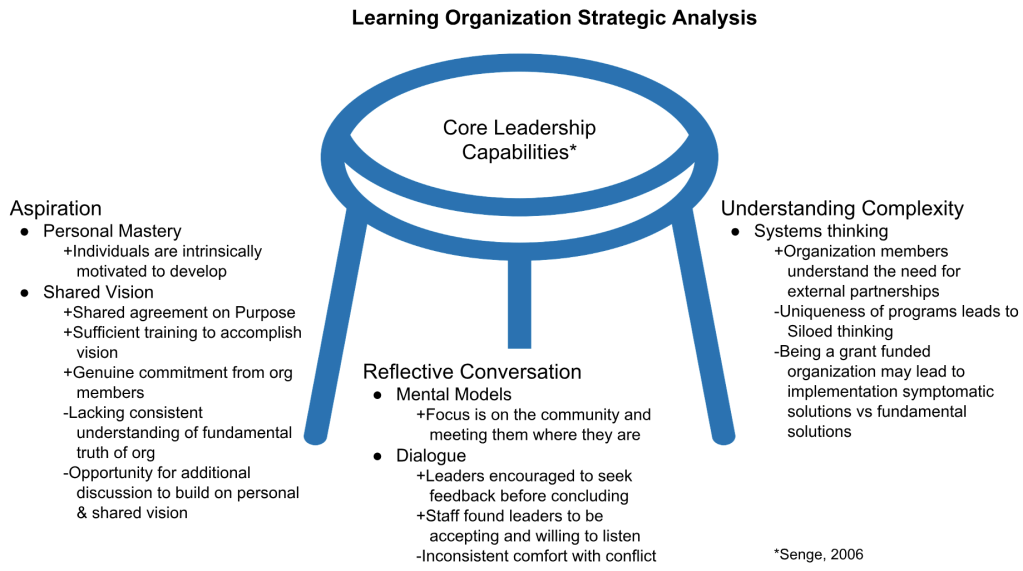
Organization Culture Assessment
Organization Culture Assessment: this strategic analysis diagram was part of a larger Organizational Leadership & Culture assessment of an Ohio-based non-profit. The process consisted of interviewing organization members across all roles, asking questions that aligned to key cultural elements. We assessed the organization against Senge’s (2006) Core Leadership Capabilities of a Learning Organization. A full size version of the analysis diagram can be found here: Learning Organization Strategic Analysis
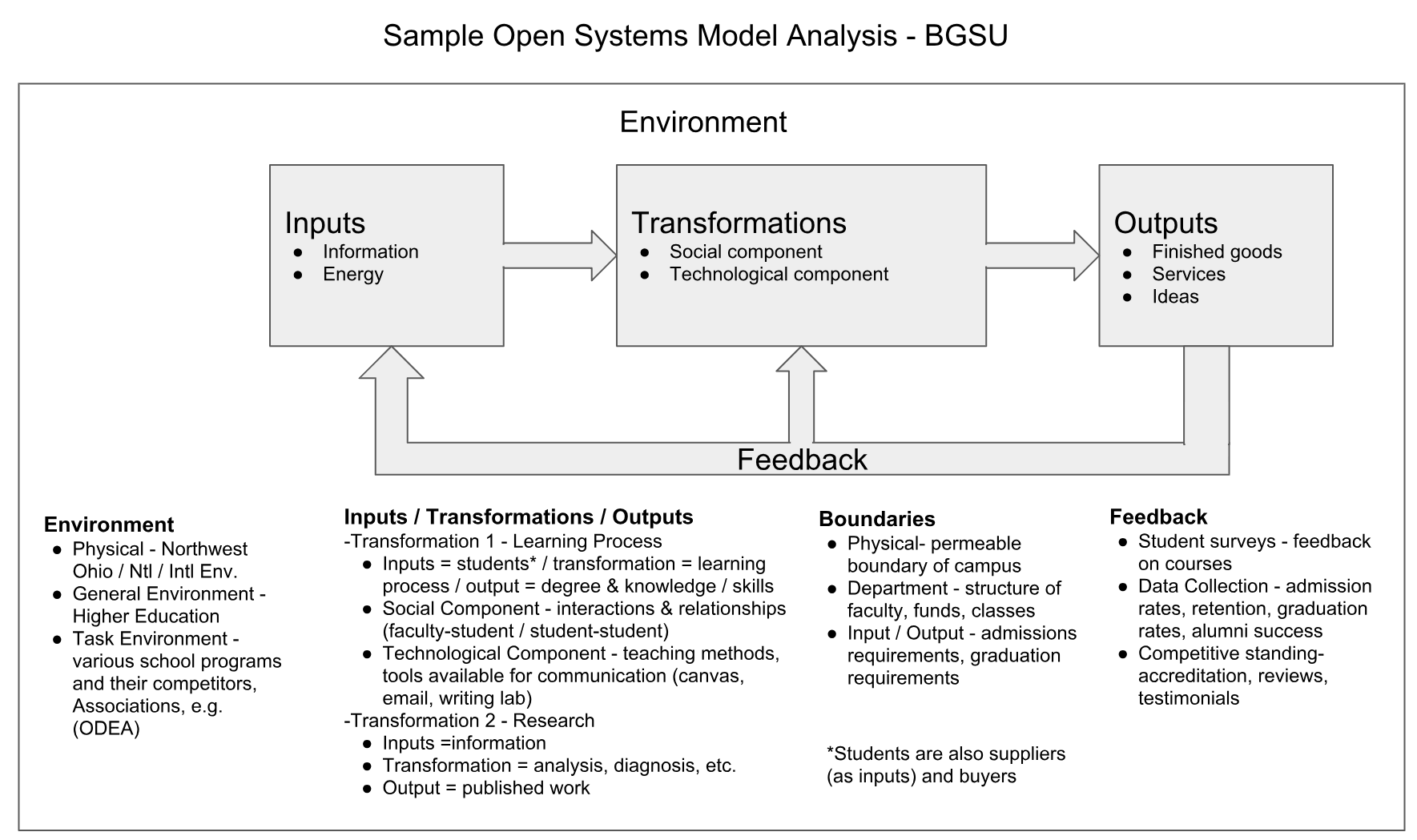
Open Systems Model Analysis – BGSU
Open Systems Model Analysis: this diagram depicts the analysis I conducted on Bowling Green State University against the Open Systems Model for our final exam in ORGD 6010. For this analysis, I reviewed the BGSU website including their strategic plan, admissions requirements, accreditations and memberships, as well as my own experience against the open systems model. According to my analysis, the university has many feedback mechanisms in place which provide evidence to suggest that they do in fact recognize themselves as an open system and adjust their strategy accordingly. For additional information you can view the full analysis: Open Systems Model Analysis of BGSU
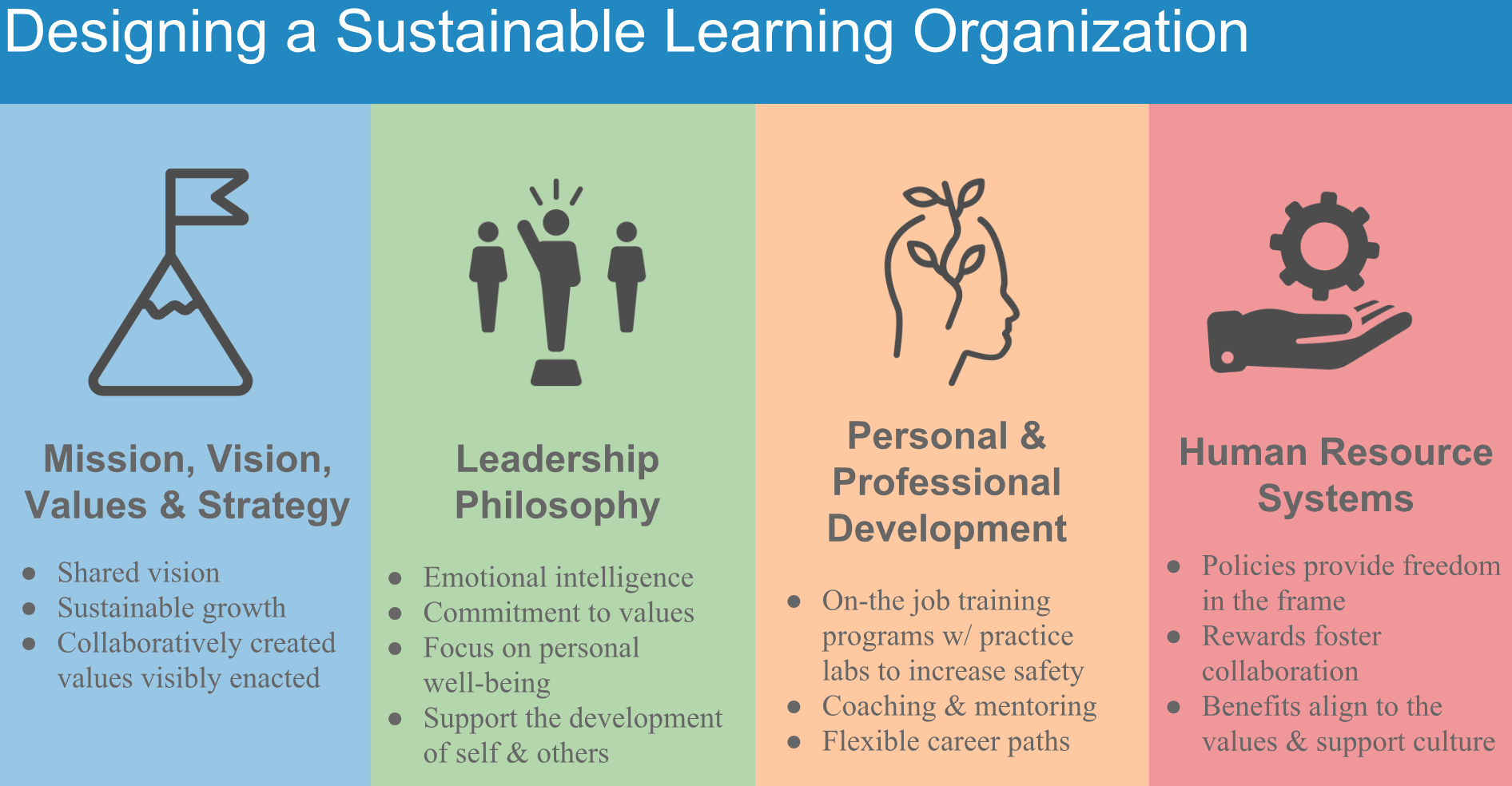
Designing a Sustainable Learning Organization
Designing a Sustainable Learning Organization: this image is a distillation of a paper I wrote in ORGD 6080 where we had the opportunity to design our ideal organization. I borrowed many concepts from Senge, the articles in our Organization Behavior Reader and what I gleaned from various ‘How I Built This’ episodes to create an organization in which I would want to work and/or lead. For more detail you can view the full paper here: The Ideal Organization – Designing a Sustainable Learning Organization
EMOD Experience
While we had a class entitled ‘Leading for Organizational Success’ I recognize that much of the coursework we completed throughout the program contributed to my current level of proficiency in this competency. I also see this competency, much like many of the other OD competencies, as a compilation of many different knowledge areas, skills and attributes and as such, break out the discussion of this competency by a few key knowledge areas including Organization Culture & Leadership, Dimensions of Diversity. The following examples of assignments, readings and external work outline the key ahas I have experienced over the last 18 months in the various aspects of this competency.
Organization Culture & Leadership
In-Class Work: The foundational readings from ORGD 6080, as well as ORGD 6010 – Introduction to Organization Development and Change helped me to recognize the complexity of organization culture and the challenge with effectively assessing, diagnosing and changing culture on a broad scale. The insights from the following readings have supported me in many assignments within and outside of class.
- Schein ‘Culture Components’ and Cameron & Quinn ‘The Competing Values Approach to Culture’ (Cummings & Worley, 2015, p. 555): Having these models helped me to recognize when espoused values and values in use may be in conflict. When reading, I would typically think about how a concept applied in my current and past work settings. In thinking about my current workplace, I noticed that our OD/HR teams tend to focus at the level of artifacts and espoused values when attempting to achieve behavioral and culture change versus diving deeper below the surface to understand the motivations behind the values in use.
- Senge’s The Fifth Discipline (2006) – I recall sitting at my kitchen table crying as I read this book because it had such a profound impact on how I came to understand individual and organization behavior. While I had heard the term Learning Organization, I really did not understand the components that went into creating and sustaining a true learning organization. Similarly, the concept of a ‘Shared Vision’ and the process to move from the a singular leader’s vision to one that is fully adopted and owned by the organization was something new. I was familiar with the concept of inquiry & advocacy, however I had only seen it used in relation to challenging conversations, rather than being the mindset of a leader to continually seek feedback from others. Finally, the concept of systems thinking which is pervasive throughout our program is something that I now understand more fully, however recognize that I still have opportunity to develop.
There were two assignments in particular that supported my understanding of organization culture. The first was our final exam in ORGD 6010 with Dr. O’Neil. Question 2 (pp. 5-13) of our exam posed the following challenge:
- Understanding organization culture is fundamental to the work of organization development:
- Define organization culture
- Discuss the steps you would take to diagnose the culture of the Global Tech organization from the ExperienceChange simulation
- Provide your assessment of the current culture of Global Tech
- Discuss how you might assist Global Tech in transforming their culture
I enjoyed this assignment for the opportunity to examine the culture of the organizations where I have done my work as an internal OD practitioner. Through application of Schein and Cameron and Quinn’s models, I was afforded terminology to express the incongruencies I saw and felt between espoused values and values in use. Additionally, this exam allowed me an opportunity to propose an approach to culture change in a safe environment, without the high stakes of a client saying no, or even yes, as at that point in time (Fall of 2017), I was not entirely confident in my ability to carry out some of the recommendations I made. What increased my confidence in this competency was the positive, supportive feedback I received from Dr. O’Neil in my analysis of not just this, but all of the exam questions. They helped me to reduce the internal dialogue that continually questioned whether I understood the concepts and allowed me to move forward in looking for ways to apply and modify the concepts to the environment in which I was working.
The second assignment was a team assignment from ORGD 6080 with Dr. Voss analyzing an organization’s culture and leadership philosophy using concepts from Senge and our Organization Behavior reader. One of our classmates was kind enough to offer up his organization to our analysis and I found this assignment fascinating as one of the first opportunities to analyze a live (e.g. not simulated) organization that was not my own. I will admit that I approached this assignment with mild trepidation, recognizing that every step of our analysis, from inquiry through feedback and recommendations would impact the organization. As such, we carefully crafted our questions to ensure they aligned to the key culture components and Senge concepts we wanted to assess. We gleaned an understanding of the culture of the organization from our classmate who worked there to ensure that our communications and process for interviews aligned to the style of the organization – even doing some of the interviews in person as we were able. Ultimately, we analyzed the results of our interviews and assessed the organization against the three legs of Senge’s ‘Core Learning Capabilities for Teams’ stool (Senge, 2006, p. xiii). Having a core framework around which to anchor our analysis was extremely helpful in order to determine how to feed it back to the client and share our learnings with the class.
As we embark on our final capstone project for ORGD 6070 – Mastering Change, again we are analyzing the culture of our client, The Avalon Foundation. One of the comments that our alumni mentor mentioned in our debrief at our first meeting was whether it might be advantageous to consider and/or share concepts of a ‘Learning Organization’. It is clear to me how pervasive the tentacles of Senge’s concepts are in our foundation, as without referencing the book, we have discussed the need to assess and/or support the organization in creating a shared vision, personal mastery, inquiry and advocacy and being cognizant of not contributing to reinforcing loops based on our inquiry or any recommendations that we make.
Application outside of Class: In my current role, I am working on a project related to an identified need for a culture shift at Froedtert Health, moving from Hierarchy to Adhocracy to support our Five-Year Strategic Plan. I am playing a significant role in supporting this process through the roll-out of a new competency model, implementation of a succession planning and talent review process as well as a more formalized executive and leader development process which includes use of 360 data to identify development needs. An overarching goal of my work is to support the shift of our organization to function as a true learning organization. While a lofty goal, I believe that any steps towards this direction and behavior change will enhance the environment.
Dimensions of Diversity
This is an area of ‘Leading for Organizational Success’ where I have made progress and also have significant development opportunities. As noted in my competency assessment, I believe that additional experience in different types of organizations as well as those that are more representative of a wide-array of diversity components will support me in further developing this competency.
In-Class Work: In ORGD 6080 – Leading for Organizational Success, we completed an assignment entitled Experience OB & Leadership Theory Team Presentation. I worked with a fantastically engaged group and one of our group members took the lead out of the gate presenting an idea for our intervention that she felt would support the desired objectives of the assignment and provide a great learning perspective for our class. The focus of our concept was utilizing key decision points of Leopold II of Belgium and his manipulation of the European powers in order to increase his foothold and exploitation of the people and resources in the Congo. Our team rallied around the idea and went full-steam ahead, efficiently putting together the presentation and activities, energized by the enthusiasm of our fearless leader. During our facilitation of the intervention, there was a noticeable shift in energy and some hesitation around answering the questions. During the debrief, Dr. Voss asked a question about whether we considered how this content might impact our class, in particular our african-american classmates. We did discuss the fact the content was rather provocative and yet decided to move forward with because of the learning we thought the activity would spur. However, in reflecting further on our approach, it may have been an opportunity to solicit feedback from a more diverse contingent of stakeholders to determine if it was the right intervention and if yes, then how we might want to ask questions about impact of the content to the participants, in addition to questions about content. As Dr. Wheeler often asked, “What happened outside? And What Happened Inside?”
Even after this experience with our assignment, I recognize that I have lots of opportunity to enhance my competence and fluency in how I consider and engage various dimensions of diversity. Just a few weeks ago, in our ‘Ideal Leader Self’ presentations for ORGD 6070 – Mastering Change, one of our classmates commented that many of the early OD theorists upon which much of OD has been built represent a rather narrow scope of society, primarily white men. This fact had not even crossed my mind prior to the comment, which causes me to reflect on my current worldview and mental models from which I operate.
I look forward to how our last semester of coursework, through ORGD 6070 – Mastering Change and ORGD 6065 – Experiencing Global OD will support me in this component of Leading for Organizational Success. In particular, I think increased experience with a non-profit will help shape the frame I bring to my client work. And I look forward to our experience in Italy and experiencing OD in a different cultural setting. One key assignment I am intrigued by is the work that SACI is doing with clothing for seniors and thinking about that dimension of diversity and how we can support the students in their work with this demographic group.