Definition: Develop, adapt and apply theories and methods of inter-group, systemic and trans-systemic change in order to increase the effectiveness of organizations or communities.
Whole system transformation…means that the entire system is involved in creating itself anew.
Cady & Dannemiller (2005)
Sample Work
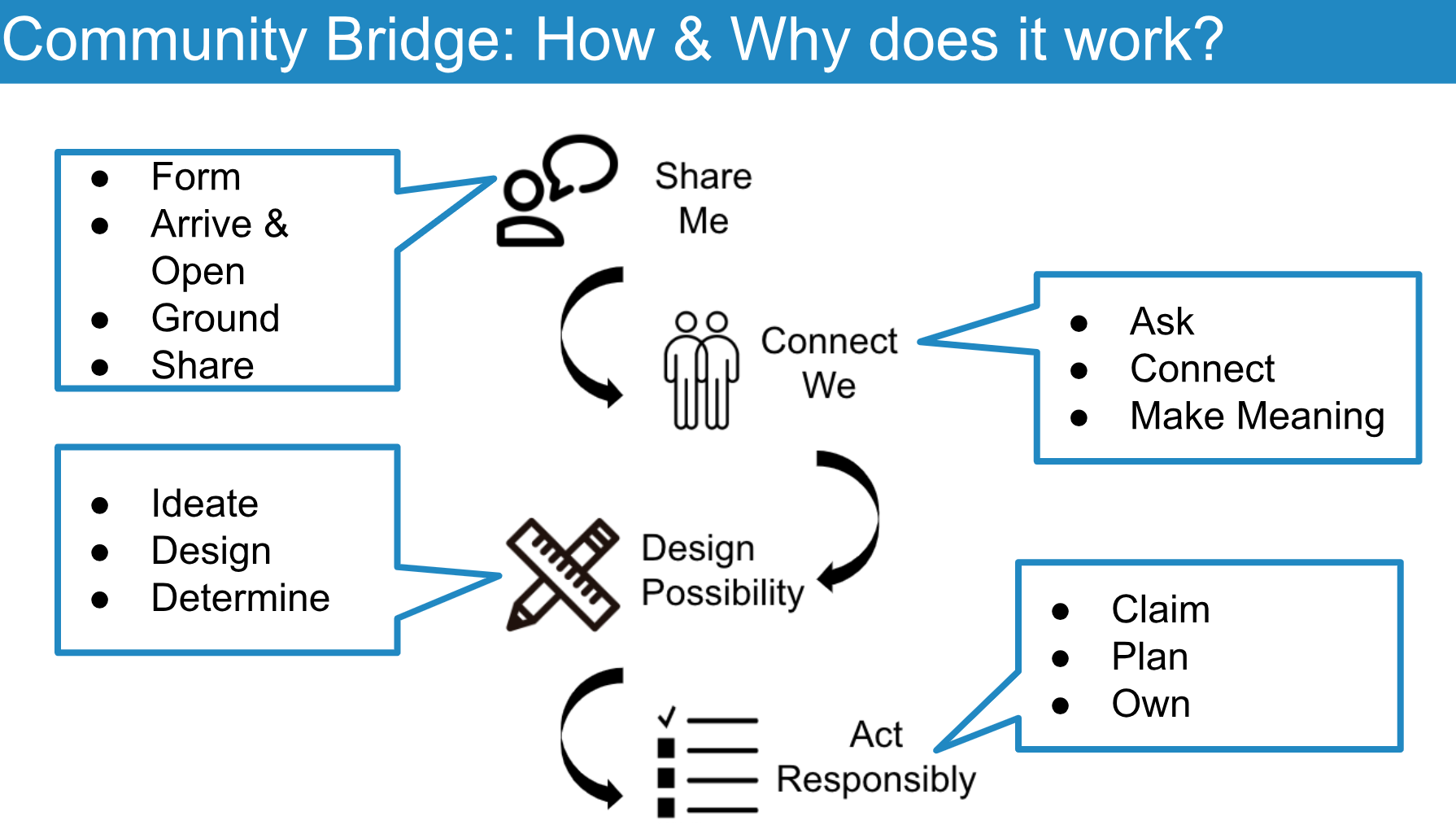
Community Bridge
Community Bridge: This is my personal collaborative change method which supports building connections, inspiring passion and accessing the collective intelligence of a system in order to generate purposeful and responsible action in a common direction. Community Bridge in constructed from passion, research and practice. It is a process that connects ancient cultural practices with modern social science theory to address our most pressing challenges. For more information view my video: Community Bridge Presentation
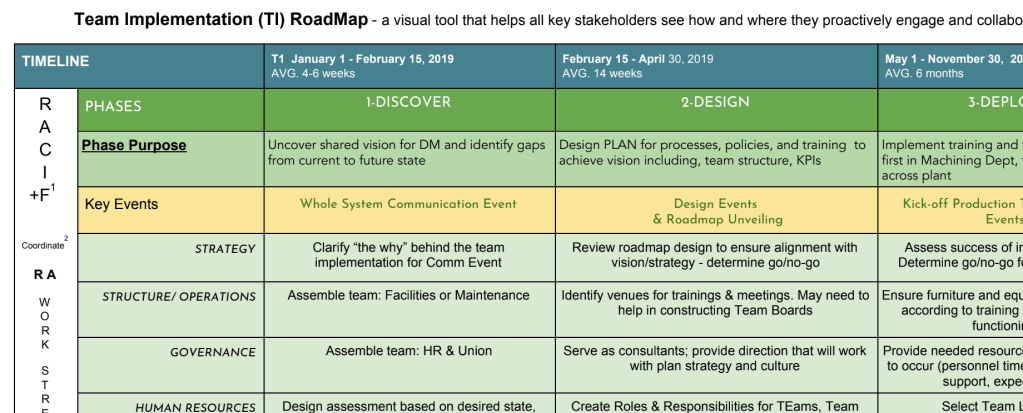
Collaborative Roadmap
Collaborative Roadmap: This portion of a much larger change roadmap was a supporting document to a change proposal we created for ORGD 6060. The proposal was designed to outline how our consulting team could engage all stakeholders in the process of implementing teams on the production floor including process, communications, training and timeline. For more information on this project, you can view the full Team Proposal and Collaborative Roadmap.
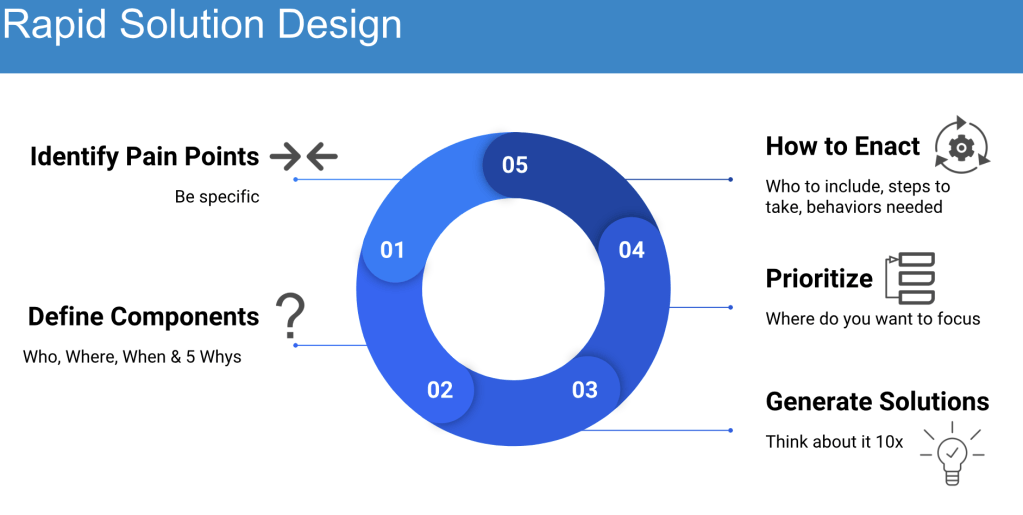
Rapid Solution Design Method
Rapid Solution Design Method: This was an extracurricular method that Violet and I created one evening and we were afforded the opportunity to test in class during ORGD 6060. The intention of the method is for it to be a method generator, though it could be used for many types of problem solving scenarios. In order to get us up and running in such a tight turn, Gabriel offered to support us with our presentation. It was great practice in blend and invention mastery, as well as designing group facilitation and is something that I would like to revisit to make some tweaks and test again. To see the full ppt visit: Rapid Solution Design
EMOD Experience
I recall in my first assignment from ORGD 6010, OD&C is… I discussed a large-scale change that my former employer went through due to multiple factors including an acquisition of an organization twice its size and going public in the same timeframe. These actions fundamentally changed the way of doing business, elements of the culture and behavior of the employees at the organization. I participated directly in many of the activities designed to support the change and acclimate our newly acquired employees, however much of the objectives I was working on were directed to me from a higher level. Having that previous experience, coupled with the tools, methods and processes we have learned throughout the EMOD program, I feel confident that I could play a strategic role at the table in guiding the strategy and objective setting process in order to support a large-scale change, whether it be within or across organizations or communities.
In-Class Work: One of the assignments that allowed us to fully synthesize many of the theories, tools and methods we have learned was the Change Roadmap Proposal for Domestic Motors that we created for ORGD 6060. In this project, our objective was to create a proposal for a client based on their need to effectively implement teams into their organization. We conducted what Dr. Cady would often call a “full swing”, conducting a brief diagnosis with the client through several opportunities to gather feedback via skype meetings, created a P.L.A.N. to stay on track with our work and submitted and presented a Change Roadmap Proposal to the client. The proposal recommends a collaborative process, collectively defining the shared vision for implementing a team structure, jointly designing a change roadmap to provide a visual that clarifies the change process, defining roles & responsibilities and co-facilitating the training and change management actions in order to create buy-in and transfer knowledge to the system in order to maintain the change after the conclusion of the implementation process. While we did not ‘win’ the competition (our solution was a bit out of their price range), I learned a great deal about how to put a proposal and change roadmap together – both of which are tools that I am using in my daily work. I also recognize that I still have opportunities to articulate my proposed process and the impact it can make in a way that the client understands (and can afford).
While we began our journey towards mastery of collaborative and whole system change competencies first through mimicking the work of others, one way in which we were truly able to test our skills was through the invention of our own Personal Method, ‘building on the shoulders of the giants’ who have gone before us. In this two part assignment – the Personal Method Chapter and the Personal Method Presentation for ORGD 6060, we had the opportunity to further hone or create a new personal method through the process of blend and/or invention mastery that formalizes who we want to be as OD practitioners and who we want to impact. I found this assignment brought a flood of emotions for me – the joy of putting to paper and pictures what I want to do with my OD skills and how big and best I want to be in the world, the overwhelming sense of gratitude and awe thinking about how I could really do those things I envisioned for my future and make a significant impact based on what I created, and the satisfaction of continuing to craft and hone my personal brand and increasing my skill in creating ‘market-ready’ deliverables.
Further evidence of my development in this area is a somewhat extracurricular activity involving the concept of invention mastery that Violet Talevich and I tested in class. It started the Saturday night of our last residency weekend in ORGD 6060 when Violet and I were chatting with Dr. Cady at his house after dinner. We were discussing the fact that a number of our cohort members were frustrated with their personal methods. Before we knew it, we had signed ourselves up to facilitate a 60 minute Rapid Solution Design activity with our class. The intention was to provide a framework that our cohort mates could use if they were still stuck finding an idea for their personal method and what it actually turned out to be was a method that Violet and I created that evening, with the support of Gabriel Szaszko at 6:00AM Sunday morning to get our ppt in order and have another set of eyes on the design. What I learned from this off-the-cuff activity was multi-factorial. First, despite the fact that we discovered multiple areas for improvement, the activity worked because we followed the ‘recipe’ for creating an engaging activity with key learning objectives using liberating structures. It showed me how far I had come in being able to put together a professional activity and change method. Though Violet and I have not had an opportunity to revisit this change method since ORGD 6060, we both felt that this was something we could apply in our own organizations and perhaps in a future consulting gig together.
Application Outside of Class: One of the greatest extra-curricular highlights of the last year for me was my involvement in the ODN Pro Bono team and specifically the Social Impact Day Event at the OD Network conference in Washington, D.C. My involvement in this project was a great way to apply the skills I learned in the EMOD program including project planning, creating a vision, systems-thinking, collaborative event design, facilitating for large groups and the list goes on. When I started working with the group, I was not quite sure what the purpose or objectives were, but I thought it would increase my skills and move me towards my goal of utilizing my OD skills in support of community organizations. It turned out that the committee’s involvement in Social Impact Day included everything from outlining our material needs for the day, soliciting non-profit participants and sharing how they might benefit from the event, designing the agenda including the infusion of various liberating structures to support rapid connections amongst a group of relative strangers and time to conduct diagnosis and design action plans. What I did not realize was the potential magnitude of the day’s impact and how, much like the butterfly effect, the impact is still unfolding in many corners of the OD world. In reflecting back, it makes sense, as we were really engaging multiple systems on many levels. Our committee included ODN members from the US and Canada, borrowing from the work that the British Columbia ODN started, we involved multiple community organizations in the DC area based on our committee connections, we involved the OD Network members who ranged from long-term practitioners to students and thusly ultimately impacted all of the organizations that the participants were part of as well.
Beyond the Social Impact Day experience at the OD Network event, I have been able to apply this knowledge and experience to our very own cohort capstone project. And our Pro Bono committee is writing article on Social Impact day, focusing on the impact on the various stakeholder groups and the implications for future of OD. What excites me about this article is the opportunity to engage other members of the OD World that did not have an opportunity to participate in the event, but may want to engage in this type of social and community OD work. Additionally, this aligns to two of my personal goals – one to contribute to a published article and the other to contribute to the OD world through application of OD concepts in unique settings.